Showing posts with label community partners. Show all posts

Monday, January 18, 2016

The CReC Epidemic

Trashers, there is an epidemic that has been plaguing America for decades. We must raise awareness for this dangerous and environmentally threatening affliction. Chronic Recycling Confusion (CReC) is real. We need to put our heads together and provide sincere and honest remedies. The fate of local recycling programs depends on it. This is a fight we can win! I'll start planning the 5K.

I personally live with someone who suffers from CReC. My boyfriend often tells me he's afraid to throw anything out in our apartment. His anxiety over being scolded for wrong bin selection is not unfounded. Although I think he's just making an excuse to not clean up around the apartment. I asked one day if he would find it helpful or patronizing to put sings up near the bins in the kitchen with what goes where. He said helpful. I made him these:

But his case of CReC is too severe The signs have "too much writing on them" making it near impossible for him to recycle properly. 

CReC is a nation wide problem that cuts across kitchen, city, town and state lines. It stems from two main obstacles: inconsistency and signage. 

Obstable 1: Inconsistency in collected recyclables

Where I live in Los Angeles, each city and neighborhood has different rules about what it collects and which bin it goes in. Just take a look at what happens to these Starbucks cups across three LA neighborhoods:
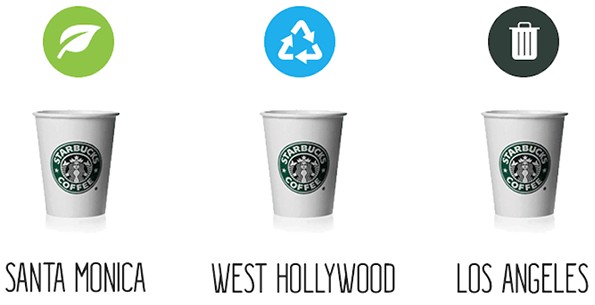
Compost, Recycle, Landfill, Oh My!
*Graphic from Recycle by City

What a city collects will depend on a few things. The first being if it has the facilities to take in different items. Not all cities can collect compost because they don't have a facility to compost it. Come cities can't even collect recycling because the don't have the infrastructure in place (ie: trucks, staff, recycling centers) or the money to implement a recycling program. Another factor is if the recycling market has a demand for the items. 

Whoa Trash Girl - what are you talking about?
Recycling is a profit based industry driven by supply and demand like any other market. A city has to collect, bundle and sell recyclables at a high enough price for them to justify the collection. So, while some cities (like Los Angeles) collect Styrofoam containers, other cities (like Glendale, CA which is adjacent to LA) do not because they cannot financially justify the significant amount of material needed to offset its cost. 
Lack of consistency in recycling is a problem that has to be tolerated more than it can be fixed. There are apps and websites being developed to make it easier to manage. Recycle by City is a website and app in development to identify what goes in which bin depending on where are try saying that 5 times fast. They don't provide information for a lot of cities yet. However, you can see by poking around the idea is to help you easily identify what is and is not recyclable in your city.

Obstacle 2: Labeling & Signage 

Raise your hand if this you:

No one (not even me) wants to stand looking at half a dozen bins trying to figure out which bin the straw, soda lid and paper cup go into. Most people don't have the patience to decipher awfully designed signs like this: 

So. Many. Words. Argh. *Eye twitch*

Or abusively colorful signs like this:

I guess I should have more sympathy for my Boyfriend. When these beauties are what's out there in the world I should be more understanding of his condition. 

Let's be honest with ourselves Trashers, we all want to do the right thing when it comes to recycling if and when it is convenient to do so. You don't want to stand and stare for ten minutes. You want to toss it in the bin get some civic duty pride points and keep on walking. Recycling programs depend on those pride points to function. Recycling programs do a disservice to themselves when they have poor signage that disempowers us from wanting to do the right thing. 

There is a movement spearheaded by Recycle Across America to standardize recycling labeling and end mass confusion while increasing recycling rates across the country. The breakthrough CReC has been searching for. 
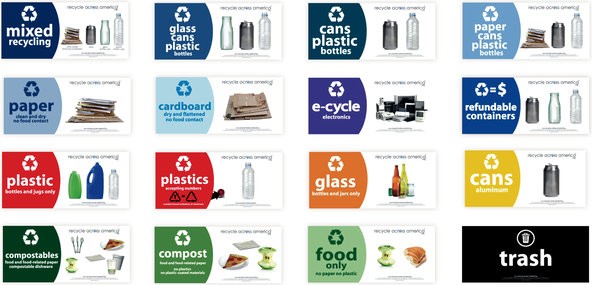
The standardized labels are available for all waste streams, even mixed ones. 

Their website does a great job of explaining why this is such an innovative and well received solution. The summary is this: clear and consistent labeling helps people effectively and correctly recycle. Which in turn benefits cities, haulers, recyclers, communities and the environment. Plus they look pretty snazzy. 

But Trash Girl...

You told us that Material Recovery Facilities sort the recycling anyway. So why can't they just sort out the non-recyclable trash at the same time?

Well, I'm glad you asked Trashers! 
Recycling centers depend on residents sorting their trash correctly so the material is not contaminated. Contamination of the recycling stream is a huge issue for MRF's because they have to pay the landfill to take the un-recyclable garbage that's been removed. Remember from earlier just North of 'Obstacle 2' that city governments need to be able to resell the recyclables they collect to maintain a profit. When paying "dumping fees" to landfills to off load the contaminated refuse, the net profit of the recycling center decreases. 
Whether cities do it themselves or hire a private company to collect your waste, it is still tax dollars at work to maintain clean and sanitary communities. Bottom line is you want to live in a clean community. You want your town to keep picking up your waste and recycling. You want your recycling center to be profitable so it stays open. You want your pride points to increase with each properly placed plastic bottle. All of that is possible when you know what goes where.

 Pride points also decrease anxiety over recycling and therefore are a cure for CReC!

As new products come onto the market, CReC will only get worse. "Can I recycle this?" will echo through communities from Los Angeles to New York City and beyond. It doesn't have to be this way. 

Recycle Across America's signs are a great start but are only a fix in the short term. Neighboring cities need to collaborate and combine resources to create regional recycling efforts. This will not only create more consistency for consumers but also make it easier to recycle en masse creating more opportunities for higher profitability. 

Local government, nonprofits and schools need resources and technology to educate the public on recycling. Partnerships between tech entrepreneurs and recycling/waste managers will yield new apps and technologies to disseminate up to date information. Expanding the Recycle by City model is a clear winner in this arena. Clear education and outreach will help keep recycling programs not just up and running but growing as well. 

Until then, a great place to start CReC treatment is your own City's website! They usually have a "waste management" or "sanitation" department that should be able to alleviate most symptoms. 

For large or more obscure items, Earth911.com is  great resource as well! 

Good luck Trashers! May the bins be ever in your favor. 


Tuesday, February 17, 2015

TerraCycle Part IV: Legacy & Letting Go

I'm back! Did ya miss me? Still settling in to ma new digs and West Coast life- a whole new city of Trash to explore! Been here about a month, but I'm back from the hiatus! As promised, here is the last installment of the TerraCycle series! 

All good things must come to an end, even a fabulously witty blog post series such as this one. College also must eventually come to an end, for most of us at least. With the daunting feeling of "Life After College" approaching, I knew I would have to decide what would become of "my baby."

In college, it's hard to think of the long game when the experience has a deadline. After TerraCycle really started becoming successful and my ego was sufficiently stroked as to how well it was going, I started making plans to set it in motion for success after my graduation. For one, the norming process I talk about in Part I, never stops. New people enter college every year and a successful program sufficiently ushers them into the culture you've created. One way we did this was by this really cool commercial that was made for the campus TV Station. But it's also about leadership. I didn't want to just hand the job onto the next Hillel person who was there, I wanted them to want to own the project even if they weren't as invested in Trash as I was and let's face it, no one was going to be as into Trash as I was. 

But I was surprised at how the mini army had taken ownership of the project and even though TerraCycle was "my baby," it was their baby too. People who had been elbow deep in it with me from the beginning were just as invested as I was in the mission and impact the program was having. Programs are only as strong as the people in them and that is exactly who I was leaving TerraCycle in the hands of. (Now I heard whispers that the program got dropped a little, as expected. But I met the current girl from Hillel who is heading the project and it seems to be in good hands). 

Implementing a successful program is hard. Letting go is harder. But any program is only as successful as the people in it. All the trash warriors and partnerships we created are the reason I left TerraCycle at Virginia Tech feeling like I did something that worked. Now, like any project, I always feel like I could have done more, but after writing this series, I realize how much was done, by students, in such a short time. Hashtag Satisfied. 

By the time I graduated, we had diverted over 20,000 items from the landfill in three and a half years, resulting in about $200 raised for our service trip to New Orleans. Not too shabby for a project inspired by a banana bar.


Things we were collecting: cookie, candy, & energy bar wrappers, chip bags, solo cups, dairy containers

Monday, December 15, 2014

TerraCycle Part II: Expansion & Obsession

A successful program isn't only about a strong idea, or plan to "scale up" but recognizing where you fall flat and creating a plan to overcome it. For me, most of the time the answer is a "who": Who do I know that will do this better? Who has the skills or network? Who is willing to touch other people's trash?

Starting with Hillel, while being a great place to jump start the program, came with a few constraints that prevented TerraCycle from realizing it's fullest potential. Working with such a specific group of students on campus made it difficult to branch out and gain traction with other groups on campus, especially environmental ones. Trash just wasn't on their radar, they were busy with transportation, energy and hooping on the quad haha. We were ready to grow, but how? Or rather...who?

We wanted to grow big and grow fast. Our first approach for a partner was the campus  Office of Sustainability. They were super into the idea and loved the initiative at a student level. But, could not condone the activity on campus- period. Sustaina-office say wha? Because the contract they had with the waste collection company was based on tonnage picked up, they were not allowed to diverge waste, at all. Meaning, any diversion of waste from normal garbage/recycling was a breech of the contract. They explained they were having the same problem with the Game Day recycling program they were trying to implement during football games. And in one email, my dreams of the first college campus to have a fully integrated TerraCycle program blew up in smoke... This was actually a blessing in disguise, because I don't think we would have had the capacity as students to deal with that much trash. 

Then came Anna who glowed with "what if possibilities": Partner small to gain big. Anna, who was a part of the Equestrian club on campus, got them to partner with us. In an instant, our reach doubled. Then, as a member of the Marching Virginians don't laugh, I got to go to all the games and Bowl games for free...it was awesome... I started collecting pop tart wrappers and chip bags from our game day breakfast & lunches. We're talking 300+ chip bags every home game. And finally, we partnered with the local one screen movie house downtown for candy wrappers. With our three major partners, we tripled our intake, extended our network and educated more students on TerraCycle and waste streams. Now partnerships can be difficult, and delicate, but these worked because we got them all on board with the mission and stuck to the script. Does celebratory dance for strong community partnerships! With a small trash collecting army behind me, we had grown the program to noteworthy size. It's all about the 'who'. 

All this talking and partnering meant I was thinking, talking or doing TerraCycle pretty much constantly, man, did I ever go to class? Trash Obsession checklist: You've recruited a small dedicated group to be elbow deep in trash the day before finals start every semester because you've convinced them it's cathartic, Check. You're walking around campus and strangers are handing you TerraCycle'able trash, Check. You're in a meeting completely unrelated to TerraCycle yet you bring it up when you notice the snacks are in wrappers you're collecting, Check. You fill half your suitcase with TC trash during your service trip to New Orleans, Check. You're introduced to new people as, "Oh yea, this is Rachel, the Trash Girl," Check. Hashtag no shame. 

One day, one of my friends asked, "Couldn't we collect something that didn't encourage us to eat so much junk?" And, as on cue as a "Let's Go" being answered with a "Hokies" meaning, right on cue for those non Hokie Nation-ers, TerraCycle announced its partnership with Solo...

Check in next week for a post about our most successful (and dirtiest) brigade. 

Things we were collecting: cookie, candy, chip, energy bar wrappers